
Rowing Terminology
Discover our helpful glossary of rowing terms and commands so you are always up to speed.
The Rowing Shell
- Board/Deck – There are both stern and bow decks on the shell. These decks form compartments to trap air for flotation in the event of swamping or flipping.
- Foot Stretcher – Adjustable plate to which the shoes are attached, allowing adjustment for length.
- Gunwale – The top edge of a shell’s side (pronounced “gunnel”).
- Hull – The actual boat. The hull is very thin and fragile. It scratches and can be punctured easily. Be especially careful when moving the boat; always listen to the commands of the coach and the coxswain. NEVER step over the hull; always walk around.
- Oarlock – “U” shaped plastic part in which the oar is placed.
- Rigger – Metal or composite “arm” attached to the exterior of the boat that holds the oar.
- Seat – On wheels that allow forward and back movement. Also, a rower’s place and # in the boat.
- Tracks – Guides in which the seat wheels roll (also called slides).
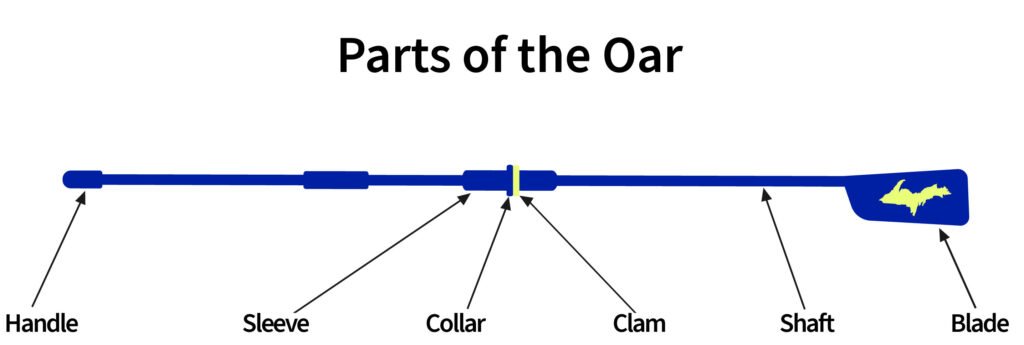
Oars
- Blade – The flat part of the oar that enters the water. Either hatchet-shaped or, in older oars, tulip (Macon blades).
- Clam – A clip-on plastic piece that fits against the collar, adjusting the load (length) on the oar.
- Collar – Plastic piece attached around the sleeve that is pressed against the oarlock, keeping the oar in the proper place (also called button).
- Handle – The oar part you hold on to; may be wood or composite with rubber grips.
- Shaft – The long, main pole of an oar that connects the handle to the blade, designed for leverage when propelling a boat.
- Sleeve – Plastic plate about 2/3 up the shaft that goes in the oarlock.
Helpful Tip
✔ Port oars are color-coded red – think of the color of port wine (starboard oars are color-coded green).
Beginner Rowing Terms
These are foundational terms that new rowers should learn right away.
- Blade – The flat end of the oar that goes in the water.
- Catch – The moment the blade enters the water at the start of the stroke.
- Catch a Crab – A common mistake when the oar blade gets trapped under water.
- Crab – When the blade gets stuck in the water; can throw off the rower’s rhythm.
- Coxswain (Cox, or Coxie) – The person sitting in the stern (sometimes the bow) of the shell who steers, gives commands to the crew, and passes on the coach’s directions to the crew. A good coxswain is just as important as the rowers, and through good steering, calling a good race plan, and motivating the crew, can make the difference between winning and losing (pronounced “cox-in”).
- Drive – The power phase where the legs push, and the oar moves through the water.
- Erg (Ergometer) – Indoor rowing machine.
- Feathering – Rotating the oar blade flat above the water after the drive to reduce wind resistance.
- Finish – The end of the stroke where the oar comes out of the water.
- Layback – The amount a rower leans back at the end (finish) of the stroke.
- Oar – The tool used to row; not a paddle!
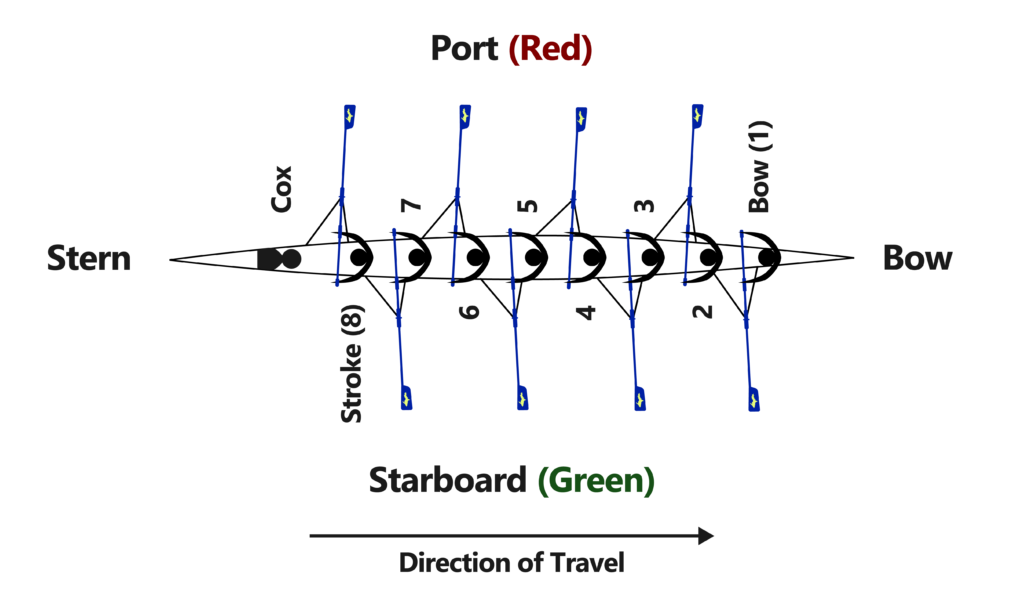
- Port (red) – Left side of the boat (when facing the bow).
- Recovery – The motion of returning to the catch position from the finish position.
- Set – The balance of the boat.
- Slide – The seat on wheels that allows the rower to move back and forth.
- Starboard (green) – Right side of the boat (when facing the bow).
- Stroke Seat – The rower who sets the rhythm for the boat.
- “Check it down” = A call for all rowers to drag their blades through the water in order to slow down or stop the boat. The call can also be made for certain rowers only, such as “check it on port” or “stern pair check it down”. “Check it down hard” usually means there is an emergency and the boat needs to be stopped immediately.
- “Weigh enough” = Stop immediately.
- “Hold water” = A call for the rowers to square their blades in the water to stop the boat quickly, or to hold the boat in a set place.
- “Let it run” = A call for all rowers to sit with blades off the water at the finish, allowing the shell to glide through the water. Done correctly, the boat will be set (balanced), and no blades will be touching the water. A good drill for correcting set problems, especially those related to lean and handle heights.
Intermediate Rowing Terms
- Body Angle – The forward lean of the upper body at the catch.
- Check – When the rower disrupts the boat’s momentum, often during the recovery, causing the boat to move towards stern.
- Digging – When the blade goes too deep in the water.
- Power 10 – A call for 10 strong strokes, often used to gain advantage.
- Push – Applying power on the oar during the drive phase by pushing hard with the feet.
- Rating – Strokes per minute.
- Ratio – The timing relationship between the drive and recovery.
- Rush – When rowers come up the slide too fast during recovery (rushing the slide).
- Skying – When the oar blade is too high above the water at the catch.
- Split Time – Time it takes to row 500 meters on the erg.
Advanced Rowing Terms
- Backsplash – Water thrown backward by the blade at the catch; minimal backsplash indicates a clean catch.
- Breaking water – refers to the blade of the oar not entering the water cleanly and efficiently at the beginning of the stroke.
- Length – The amount of water the oar covers during the stroke.
- Puddles – The swirling marks left by the oar; evenly spaced puddles indicate consistency.
- Ratio Control – Fine-tuned control over the relationship of stroke phases for efficiency.
- Run – The distance the boat travels between strokes.
- Seat Racing – A method of comparing rowers by switching seats during practice races.
- Swing – When the whole crew rows in perfect unison and the boat feels light.
Moving Rowing Shell Into the Water – Commands From the Coxswain
When the coach or the coxswain is talking, no one else should be saying a word.
*Important* Do not perform the action until the coxswain says “Ready.”
“All hands on” = Put both hands on gunwale of shell.
“Up to waist, ready up” = Pick up shell, hold at waist level.
“Up to shoulders, ready up” = Lift to shoulder (make sure to keep the gunwales and the boat level – pay attention to people behind and in front of you).
“Walk it out” = Move the shell forward slowly.
“Up overhead, ready up” = Move one hand to the opposite gunwale and push the boat overhead with both hands.
”Roll to water, ready roll” = Gently roll the shell into the water and hold steady.

Rower Positions (seats)
Each seat in the boat is numbered. Going from bow to stern in an eight, for example, the seats would be 1 through 8 & cox. Two of the seats, however, are more commonly given a different name. The #1 seat (closest to the bow) is also called “bow”. The rowing seat closest to the stern is also called “stroke”. Rowers are often called by their seat number, both by the coach and coxswain, so always be aware of your seat.
The coach or coxswain will often call for groups to row according to their place in the boat; ie: bow pair or stern four.
Additionally, rowers need to be aware of which side they are rowing (port or starboard) as rowing commands are often given by side, such as “check it down on port.”
Types of Shells (boats)
- Single (1x) – One rower with two oars (scull)
- Double (2x) – Two rowers, each with two oars (scull)
- Quad (4x) – Four rowers, each with two oars (scull)
- Pair (2-) – Two rowers, each with one oar (sweep)
- Straight Four (4-) – Four rowers, each with one oar (sweep) and no coxswain
- Four With (4+) – Four rowers, each with one oar and a coxswain (sweep)
- Eight (8+) – Eight rowers, each with one oar and a coxswain (sweep)


